
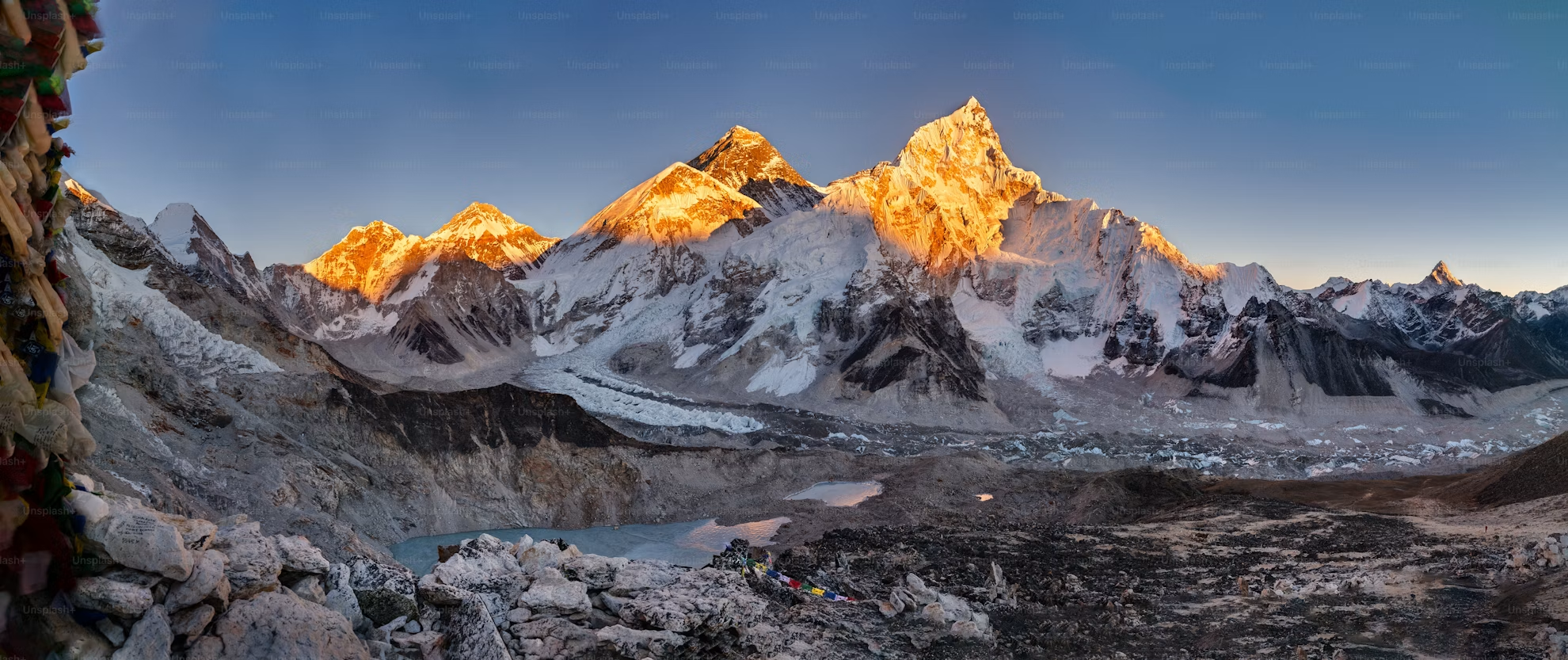
Mount Everest Expedition (8,848.86m) – South Col Route
A 47-day full-service expedition to the summit of the world's highest mountain via the South Col route in Nepal, including acclimatization rotations through the Khumbu Icefall to Camps I-IV.
- Duration 47 Days
- Difficulty Extreme
- Group Size 15 People
- Max Altitude 8848m
- Region Everest
Overview
Standing at 8,848.86m in the Mahalangur range, Mt. Everest (Sagarmatha to the Nepali, Chomolungma to the Tibetans) is the highest point on Earth and the ultimate objective for mountaineers worldwide. This South Side expedition follows the classic route pioneered by Sir Edmund Hillary and Tenzing Norgay Sherpa in 1953, approaching via the Khumbu Icefall, Western Cwm, Lhotse Face, and South Col to the summit. The journey begins with the classic trek through Sagarmatha National Park, passing through Namche Bazaar, Tengboche, and Dingboche before reaching Everest Base Camp at 5,364m, where the true climbing phase begins. From Base Camp, the team undertakes a series of acclimatization rotations through the Khumbu Icefall to Camp I, across the Western Cwm to Camp II, and up the Lhotse Face to touch Camp III, building the physiological adaptation and technical familiarity required before the final summit push. After a period of rest and close weather monitoring, climbers push through Camp IV on the South Col and into the Death Zone above 8,000m, where supplemental oxygen becomes essential, aiming for a pre-dawn summit that rewards climbers with unobstructed views across Lhotse, Nuptse, Makalu, Cho Oyu, and the curvature of the Earth itself. Every stage of the expedition is supported by experienced climbing Sherpas, a fully serviced Base Camp, and continuous weather forecasting, giving members the structure and safety margin this extreme, high-altitude objective demands.
Itinerary
-
Day 1 Arrival in Kathmandu
Arrive at Tribhuvan International Airport and transfer to the hotel. Rest and freshen up after the flight.
-
Day 2 – 3 Permits, Briefing, Gear Check & Shopping
Complete official documentation and permit procedures. Attend expedition briefing covering gear, itinerary, and team introductions, followed by final shopping for essentials.
-
Day 4 Fly to Lukla & Trek to Phakding
Scenic mountain flight to Lukla, followed by an easy trek along the Dudh Koshi river to Phakding.
-
Day 5 Trek to Namche Bazaar
A long uphill trek through pine and rhododendron forest inside Sagarmatha National Park to reach the Khumbu region's commercial hub.
-
Day 6 Acclimatization Day in Namche Bazaar
Rest day with an optional hike to the Everest View Hotel, Sherpa Culture Museum, or Khumjung village.
-
Day 7 Trek to Tengboche
Trek to the spiritual heart of the Khumbu, home to the region's most significant monastery, with sweeping views of Everest, Nuptse, Lhotse, and Ama Dablam.
-
Day 8 Trek to Dingboche
Descend through rhododendron forest, cross the Imja river, and climb gradually to the summer valley of Dingboche.
-
Day 9 Acclimatization Day in Dingboche
Rest and acclimatize with a short hike around the Imja Tse valley for improved altitude adjustment.
-
Day 10 Trek to Lobuche
Climb to the ridge behind Pheriche, pass memorials at Dughla, and ascend the terminal moraine of the Khumbu Glacier to Lobuche.
-
Day 11 Trek to Everest Base Camp
Follow the Khumbu Glacier moraine to reach the foot of the world's highest mountain, marking the start of the climbing phase.
-
Day 12 – 16 Puja Ceremony, Training & Acclimatization
Participate in the traditional puja blessing ceremony before climbing. Conduct ladder practice, fixed-line technique, oxygen system training, and crevasse rescue drills over several days at Base Camp.
-
Day 17 Climb to Camp I
First rotation through the Khumbu Icefall's crevasses and ladders to reach Camp I at the edge of the Western Cwm.
-
Day 18 Touch Camp II & Descend to Camp I
Climb through the Western Cwm to Camp II, then descend back to Camp I to rest overnight.
-
Day 19 – 20 Rest Days at Base Camp
Descend to Base Camp and rest for a few days with short hikes and rotations to keep the team acclimatized before the second rotation.
-
Day 21 Second Rotation: Camp I
Second climb up through the icefall to Camp I to further the team's acclimatization.
-
Day 22 Climb to Camp II
Ascend the Western Cwm to Camp II for an overnight stay at higher altitude.
-
Day 23 Rest and Acclimatization at Camp II
Additional acclimatization day at Camp II with an optional hike toward the West Shoulder.
-
Day 24 Touch Camp III & Descend to Camp II
Climb the Lhotse Face to touch Camp III at 7,200m before descending back to Camp II to rest.
-
Day 25 Descend to Base Camp
Return to Base Camp to rest and recover ahead of the final summit push.
-
Day 26 – 32 Rest at Base Camp / Optional Kathmandu Fly-out
Extended rest period while the expedition leaders monitor weather forecasts and determine the timing of the final summit push. Members may descend to Namche or fly to Kathmandu for comfort (own expense) while climbing Sherpas set up the higher camps for the summit push.
-
Day 33 Summit Push: Climb to Camp II
Return through the Khumbu Icefall to Camp II as the summit weather window opens.
-
Day 34 Rest Day at Camp II
Rest and final preparation at Camp II ahead of the push to Camp III.
-
Day 35 Climb to Camp III
Ascend the fixed lines on the Lhotse Face to Camp III. Supplemental oxygen use begins from this point.
-
Day 36 Climb to Camp IV (South Col)
Push into the Death Zone to reach Camp IV on the South Col, the final staging point for the summit attempt.
-
Day 37 Summit Mount Everest
Begin the midnight summit push to reach the top of the world at dawn. Members are permitted a maximum of 15-20 minutes at the summit before descending to Camp III or Camp II.
-
Day 38 Descend to Camp II
Continue the descent from the higher camps back to Camp II to rest and recover.
-
Day 39 Descend to Base Camp
Final descent through the Khumbu Icefall back to Base Camp to celebrate the successful summit.
-
Day 40 Base Camp Clean-Up
Pack up equipment and clean up the campsite as part of responsible expedition practice, before preparing to trek out.
-
Day 41 Trek Down to Pheriche
Descend past Gorak Shep and Lobuche to Pheriche, the Khumbu's Himalayan Rescue Association outpost.
-
Day 42 Trek Down to Namche Bazaar
Continue the descent via Tengboche back to Namche Bazaar.
-
Day 43 Trek Back to Lukla
Retrace the trail back through forest and suspension bridges to Lukla.
-
Day 44 Fly Back to Kathmandu
Morning mountain flight back to Kathmandu, followed by rest and a farewell dinner with the expedition team.
-
Day 45 Final Departure
Transfer to Tribhuvan International Airport for departure.
-
Day 46 – 47 Contingency Days
Buffer days reserved to absorb flight delays, weather disruptions, or an extended summit weather window.
Cost Details
What’s Included
- Common Base Camp facilities: dining, kitchen, communication, toilet, and shower tents
- 60kg personal baggage allowance carried by porters to and from Base Camp
- Mount Everest expedition permit and Sagarmatha National Park permit
- Summit certificate issued upon a verified successful climb
- Khumbu Icefall route fee and summit rope fixing charge
- Solar and generator power for charging electronic devices at Base Camp
- Applicable government taxes and company service charges
- Camp I-IV tented services, including sleeping tents shared two members per tent
- Experienced Base Camp manager, cook, and kitchen helpers
- High-altitude, medical, and helicopter rescue insurance for field staff
- One experienced climbing Sherpa guide per member
- 4-star hotel accommodation in Kathmandu with breakfast, single occupancy
- One official Nepal Government Liaison Officer
- Domestic flights Kathmandu-Lukla-Kathmandu with airport tax
- One welcome and one farewell dinner in a typical Nepali restaurant
- 6 bottles of oxygen per member and 3 bottles per climbing guide, with mask and regulator set
- First aid medical kit and helicopter rescue coordination
- Full board meals at Base Camp: Continental, Nepali, Chinese, and Indian cuisine
- Walkie-talkie communication set and weather forecasting throughout the expedition
- Individual box tent, thick mattress, and pillow at Base Camp
- International and domestic airport pick-up and drop-off
- Garbage management and disposal fees
What’s Excluded
- Nepal entry visa fee
- Extra oxygen bottles beyond the included allocation (chargeable per bottle)
- Lunch and dinner during stays in Kathmandu
- Personal climbing and trekking gear
- Wi-Fi, satellite phone usage, laundry, and beverages during the expedition
- International airfare to and from Nepal
- Drone or special filming permit
- Summit bonus for climbing Sherpa and Base Camp kitchen staff
- Personal travel, high-altitude, and rescue evacuation insurance
Highlights
- Summit of the world's highest peak: Stand at 8,848.86m, the highest point on Earth.
- Sherpa culture: Pass through Namche Bazaar, Tengboche Monastery, and traditional Khumbu villages.
- Full-board base camp service: Dining tent, communication tent, shower tent, and freshly cooked meals at Base Camp.
- Panoramic 8,000m views: Views of Lhotse, Nuptse, Makalu, and Cho Oyu from the higher camps.
- Khumbu Icefall: Navigate one of the most technical and dynamic sections of the route.
- Summit certification: Official summit certificate issued upon a verified successful climb.
- Professional climbing support: One experienced climbing Sherpa guide per member with dedicated oxygen supply.
- Sagarmatha National Park: A UNESCO World Heritage Site home to snow leopards, red pandas, and musk deer.
Why Choose This Expedition
- Weather-informed summit push: Continuous weather forecasting used to time the final summit attempt.
- Full base camp comfort: Individual box tents, thick mattresses, solar power, and fresh food resupply.
- Extended acclimatization plan: Multiple rotations through Camps I-III build the acclimatization needed for a safer summit push.
- 1:1 Sherpa guide ratio: Each member is paired with a dedicated, experienced climbing Sherpa.
- Helicopter rescue on standby: Dedicated rescue coordination in case of emergency.
- Comprehensive oxygen supply: Multiple bottles per member and guide, with backup bottles available.
Essential Information
The primary climbing window is Spring (April-May), when winds are calmer and temperatures are milder, giving fixed-rope teams a stable weather window near the end of May. Autumn (September-November) is a secondary option with fewer expeditions on the mountain but a shorter summit window.
Rated Extreme. Requires prior high-altitude mountaineering experience, ideally on a peak above 6,500m, along with proficiency in the use of crampons, fixed ropes, jumars, and rappelling technique. Climbers pass through the Death Zone above 8,000m where supplemental oxygen is mandatory.
4-star hotel in Kathmandu on a bed-and-breakfast basis. Teahouse/lodge stays during the approach trek. Full-board camping service at Base Camp with individual box tents, and shared high-altitude tents at Camps I-IV.
Full board meals throughout. Continental, Nepali, Chinese, and Indian cuisine served at Base Camp with fresh vegetables, meat, and fruit resupplied regularly. High-altitude food such as freeze-dried meals, muesli, soup, and dry fruits is provided at the higher camps.
- Mt. Everest Expedition Permit: Issued by the Nepal Department of Tourism for the climbing season.
- TIMS Card: Trekkers' Information Management System card for the approach trek.
- Sagarmatha National Park Permit: Entry permit for the national park and conservation area.
- Khumbu Icefall Route Fee: Charged by the Sagarmatha Pollution Control Committee for icefall route maintenance.
- Oxygen mask and regulator: Summit-rated mask and regulator set, provided by the operator
- Sleeping bag: Extreme-cold rated sleeping bag for camp use
- Climbing hardware: Crampons, ice axe, harness, jumar, carabiners, and belay device
- Down suit: 8,000m-rated insulated down suit for summit push
- Mountaineering boots: High-altitude double or triple boots rated for extreme cold
- Personal kit: Personal medicines, sunscreen, and high-altitude goggles
- Base and mid layers: Thermal base layers, fleece, and insulated mid layers
Multiple rest and acclimatization days are built into the itinerary, along with rotations to Camps I, II, and III before the summit push. The Death Zone above 8,000m requires supplemental oxygen at all times. Watch for headache, nausea, and dizziness as early symptoms of altitude sickness, and report symptoms to the expedition doctor immediately.