Gokyo Lake via Cho La Pass Everest Base Camp Trek
A 17-day high-altitude circuit combining the turquoise Gokyo Lakes, the glacial Cho La Pass (5,420m), and Everest Base Camp with a Kala Patthar sunrise finale, the ultimate all-in-one Everest region trek.
- Duration 17 Days
- Difficulty Strenuous
- Group Size 12 People
- Max Altitude 5555m
- Region Everest
Overview
The Gokyo to Everest Base Camp Trek, also known as the Everest Circuit Trek, is one of the most rewarding high-altitude adventures in the Himalayas. This 17-day journey combines two of the Everest region's most iconic destinations into a single route, taking trekkers through dramatic landscapes, sacred valleys, and remote mountain terrain rarely experienced on the classic Everest Base Camp trail alone.
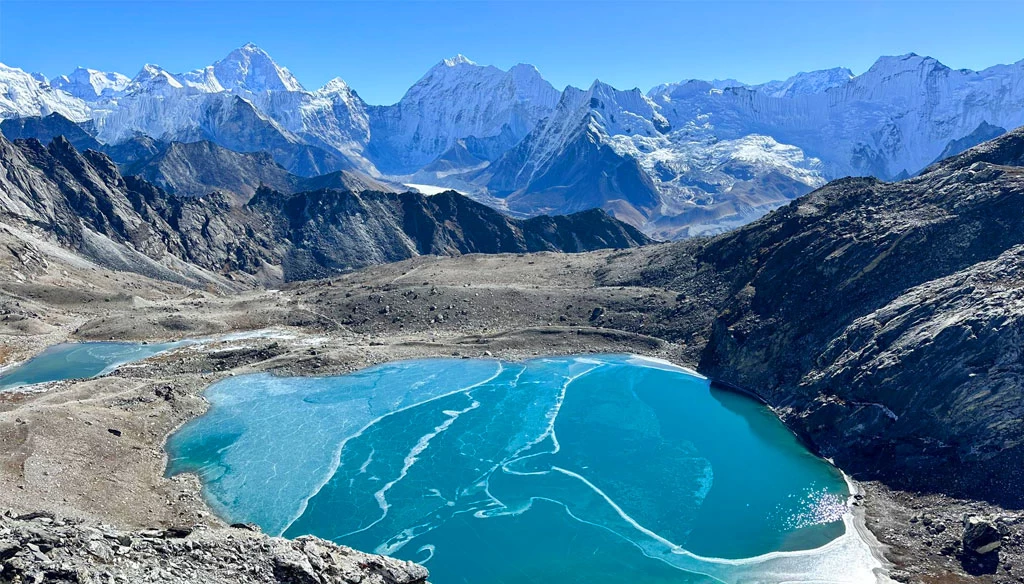
The adventure begins with a flight from Kathmandu to Lukla, then follows the Dudh Koshi River valley through Namche Bazaar, the cultural and commercial heart of the Sherpa people. Heading northwest, the route climbs through Phortse Thanga and Machhermo to the breathtaking Gokyo Lakes, a series of glacial lakes beneath towering Himalayan giants.
The ascent of Gokyo Ri (5,360m) rewards trekkers with a panorama encompassing Cho Oyu, Everest, Lhotse, and Makalu. From Gokyo, the trek's most challenging chapter follows: the crossing of Cho La Pass at 5,420m, a high glacier pass demanding a full day of effort over icy terrain, before descending to Dzongla and Lobuche to rejoin the classic Everest Base Camp trail.
The emotional high point arrives at Everest Base Camp (5,364m), followed the next morning by a final climb to Kala Patthar (5,555m) for the most celebrated sunrise view of Everest's south face. The return journey descends through Dingboche and Namche Bazaar to Lukla, where a flight returns trekkers to Kathmandu.
Itinerary
-
Day 1 Arrival in Kathmandu
Arrive at Tribhuvan International Airport and transfer to a 5-star hotel. Evening trek briefing.
-
Day 2 Fly to Lukla & Trek to Phakding
Fly from Kathmandu to Lukla (35 minutes), or in peak months drive to Manthali/Ramechhap and take a shorter flight, then trek to Phakding along the Dudh Koshi River.
-
Day 3 Trek to Namche Bazaar
Cross the Dudh Koshi on suspension bridges and enter Sagarmatha National Park before a steep climb to Namche Bazaar.
-
Day 4 Acclimatization Day at Namche
Rest day with an optional hike to Hotel Everest View for one of the first close-up sightings of Mount Everest.
-
Day 5 Trek to Phortse Thanga
Climb over Khumjung hill and descend along the northern side of the Dudh Koshi River to Phortse Thanga, leaving the main EBC trail behind.
-
Day 6 Trek to Machhermo
Climb through thorny alpine scrub and rhododendron forest, following the Dudh Koshi River past waterfalls to the village of Machhermo.
-
Day 7 Trek to Gokyo
Climb a ridge with first views of Cho Oyu, cross the terminal moraine of the Ngozumpa Glacier, and arrive at the first of the turquoise Gokyo Lakes.
-
Day 8 Hike Gokyo Ri & Return to Gokyo
Climb Gokyo Ri (5,360m) for a panorama spanning four 8,000m peaks — Cho Oyu, Everest, Lhotse, and Makalu — then return to Gokyo.
-
Day 9 Trek to Thangnak
Cross the Ngozumpa Glacier to the small settlement of Thangnak, the staging point for the Cho La Pass crossing.
-
Day 10 Cross Cho La Pass to Dzongla
A full, demanding day crossing the glaciated Cho La Pass (5,420m) over icy terrain and steep ascents, descending to the scenic village of Dzongla.
-
Day 11 Trek to Lobuche
Rejoin the classic Everest Base Camp trail, trekking to Lobuche past views of the Khumbu Glacier.
-
Day 12 Trek to Everest Base Camp & Gorak Shep
Follow the Khumbu Glacier to Everest Base Camp at 5,364m, the trek's emotional high point, then return to Gorak Shep for the night.
-
Day 13 Kala Patthar Sunrise & Descend to Dingboche
Pre-dawn climb to Kala Patthar (5,555m) for the most celebrated sunrise view of Everest's south face, then descend through Gorak Shep to Dingboche.
-
Day 14 Trek to Namche Bazaar
Retrace the route down through Pangboche and Tengboche back to Namche Bazaar.
-
Day 15 Trek to Lukla
Final descent down the Dudh Koshi valley back to Lukla.
-
Day 16 Fly back to Kathmandu
Fly from Lukla to Kathmandu (35 minutes), or via Manthali/Ramechhap plus a shared vehicle drive in peak months. Overnight at a 3-star hotel.
-
Day 17 Final Departure
Transfer to the airport for departure. Optional sightseeing at Kathmandu Durbar Square, Pashupatinath Temple, Swayambhunath, Boudhanath, and Bhaktapur can be scheduled either before or after the trek.
Cost Details
What’s Included
- Airport pick-up and drop-off by private vehicle
- Sagarmatha National Park Entry Permit and Khumbu Pasang Lhamu Rural Municipality Entry Permit
- Guided city tour of Kathmandu and Bhaktapur, scheduled before or after the trek
- All local taxes and entry fees
- Full board meals (breakfast, lunch, dinner with tea/coffee) during the trek
- Teahouse accommodation during the trek
- English-speaking trekking guide, including salary, insurance, meals, and accommodation
- Porter service, including insurance
- Hotel accommodation in Kathmandu with breakfast, 5-star standard, twin-sharing
- Kathmandu–Lukla–Kathmandu flights (or Manthali/Ramechhap routing in peak months)
What’s Excluded
- Personal shopping and cold beverages
- Personal travel and trekking insurance
- Tips for guide, porter, and driver
- International airfare to and from Nepal
- Nepal visa fee
Highlights
- Everest Base Camp: Stand at the foot of the world's highest mountain beside the Khumbu Glacier.
- Kala Patthar sunrise: Climb to 5,555m for the most celebrated sunrise view of Everest's south face.
- Sherpa culture: Namche Bazaar and Khumjung offer deep immersion in Sherpa life and Buddhist tradition.
- Gokyo Ri: A single vantage point revealing four 8,000m peaks: Cho Oyu, Everest, Lhotse, and Makalu.
- Ngozumpa Glacier: Nepal's largest glacier, skirted on the approach to and departure from Gokyo.
- Gokyo Lakes: A series of glacial lakes with still, turquoise waters reflecting the surrounding Himalayan giants.
- Sagarmatha National Park: A UNESCO World Heritage Site of glaciers, forest, and rare high-altitude wildlife.
- Cho La Pass: A demanding glacier crossing at 5,420m linking the Gokyo Valley to the classic EBC trail.
Why Choose This Trek
- Full support included: Guide, porter, permits, and flights arranged throughout.
- A genuine mountaineering-style challenge: The Cho La Pass glacier crossing offers a taste of technical terrain without requiring climbing skills.
- Comfortable bookend stays: 5-star Kathmandu hotel with a guided city tour of Kathmandu and Bhaktapur before or after the trek.
- Fewer crowds: The Gokyo Valley sees far less foot traffic than the standard EBC trail.
- The ultimate all-in-one Everest experience: Combines Gokyo Lakes, Cho La Pass, and Everest Base Camp in a single circuit rather than a there-and-back trail.
- Extended acclimatization: 17 days allows gradual altitude gain plus a full rest day at Namche and time built in around Gokyo.
Essential Information
Spring (March–May) and autumn (September–November) offer the clearest views and safest conditions for crossing Cho La Pass. Winter brings heavy snow and possible pass closure; monsoon (June–August) brings cloud cover and flight disruption to Lukla.
Rated strenuous. Around 5–8 hours of walking per day, with the Cho La Pass crossing involving icy, glaciated terrain over a full 7–8 hour day. Reaches 5,555m at Kala Patthar. Prior high-altitude trekking experience and good fitness are recommended; a guide with pass-crossing experience is essential.
Teahouse/lodge accommodation on a shared, twin-sharing basis throughout the trek, more basic in Gokyo, Thangnak, and Dzongla than in Namche, bookended by a 5-star hotel in Kathmandu and a 3-star hotel after the trek.
Full board meals included during the trek — dal bhat, noodles, soups, momos, and pasta are common, with bakery items available in Namche. Vegetarian options are widely available at teahouses.
- Khumbu Pasang Lhamu Rural Municipality Entry Permit: Local government permit, obtained in Lukla or Monjo
- Sagarmatha National Park Entry Permit: Required to enter the national park, checked at the Monjo gate
- Rain/wind jacket: Windproof/waterproof outer layer and trekking pants
- Personal kit: Personal medicines, altitude medication as advised by a doctor, and toiletries
- Sun protection: Sunglasses (ideally glacier-rated), sunscreen, and a reusable water bottle
- Trekking boots: Sturdy, broken-in boots with warm socks and gaiters for the Cho La Pass snowfield
- Headlamp: Essential for the pre-dawn Kala Patthar climb and early Cho La Pass start
- Down jacket: Insulated jacket plus thermal base layers and warm gloves
- Sleeping bag: Four-season rated bag, often provided by the trekking agency
- Trekking poles: Recommended for glacier moraine and steep descents
- Microspikes/crampons: Often needed for the icy sections of the Cho La Pass crossing
Kala Patthar at 5,555m is the trek's highest point, with Cho La Pass at 5,420m the most demanding single day. Acclimatization matters above 3,000m — drink 3–4 liters of water daily, walk at a steady pace, and watch for headache, nausea, and dizziness as early symptoms of altitude sickness. Discuss altitude medication with a doctor before departure.