
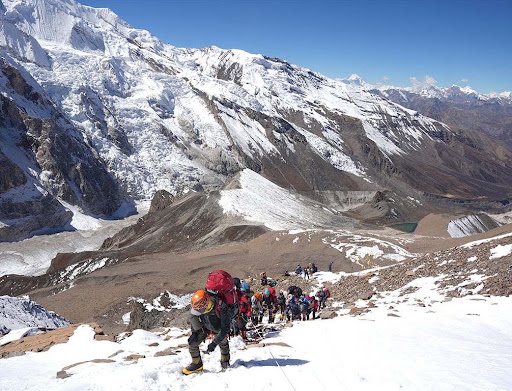
Himlung Himal 7K Expedition
A 31-day Himlung Himal (7,126m) climb in Naar-Phu: a non-technical peak ideal for 8,000m prep.
- Duration 31 Days
- Difficulty Strenuous
- Group Size 8 People
- Max Altitude 7126m
Overview
Himlung Himal (7,126m) rises in Nepal's western region above the ancient Tibetan-influenced village of Phu, in the Naar-Phu Valley northeast of Annapurna and northwest of Manaslu. The valley officially opened to foreign expeditions and trekkers in 1992, but remains a restricted area today, requiring both a regional area permit and a climbing permit to enter.
Far less visited than the Khumbu, the Naar-Phu Valley offers scenery that rivals it, with views toward Manaslu, Annapurna, Machhapuchhre, and Gangapurna along the approach. Himlung was first summited by a French team, with a second successful ascent roughly a decade later — and it remains one of the least-crowded 7,000m objectives in Nepal.
Climbers consistently describe Himlung as one of the safer and more straightforward 7,000m routes in the Himalaya, with a standard route across snow and ice and no technical rock-climbing sections. This makes it a popular and moderate stepping stone for climbers preparing for future 8,000m attempts on peaks such as Manaslu, Cho Oyu, or Shishapangma. The climbing season runs in spring and autumn.
The approach follows the Phu River through Koto, Dharmasala, Meta, Kyang, and Phu Gaon, one of the region's most significant old Buddhist settlements, before reaching Himlung Base Camp (4,850m) in a subalpine zone of grass and greenery. The valley's proximity to Tibet gives its villages a distinctly Tibetan cultural character rarely found elsewhere in Nepal.
Itinerary
-
Day 1 Arrival in Kathmandu
Arrive at Tribhuvan International Airport and transfer to a 5-star hotel.
-
Day 2 Rest, Preparation & Briefing
A day for gear shopping, expedition preparation, and the official briefing at the Department of Tourism.
-
Day 3 Drive to Besisahar
A private vehicle drive from Kathmandu to Besisahar, the gateway to the Annapurna and Naar-Phu region.
-
Day 4 Drive to Koto
Continue by local jeep along the Marsyangdi valley road to Koto, the entry point to the Naar-Phu Valley.
-
Day 5 Trek to Meta
Enter the restricted Naar-Phu Valley, trekking along the Phu River through remote, dramatic terrain to Meta.
-
Day 6 Trek to Phu Gaon
Continue through Kyang to Phu Gaon, one of the region's most significant historic Buddhist settlements, close to the Tibetan border.
-
Day 7 Acclimatization Day at Phu Gaon
A rest day to explore the ancient village and acclimatize before continuing toward Base Camp.
-
Day 8 Trek to Himlung Base Camp
Arrive at Himlung Base Camp, set in a subalpine zone of grass and greenery at the foot of the mountain.
-
Day 9 – 24 Climbing Period & Summit Push on Himlung Himal
An extended climbing period allowing multiple rotations between Base Camp and the higher camps for acclimatization and load-carrying, culminating in a summit push on the standard snow-and-ice route when conditions allow.
-
Day 25 Trek Base Camp to Phu Gaon
Clean up Base Camp and begin the descent, retracing the route back to Phu Gaon.
-
Day 26 Trek to Meta
Continue the descent back down the Phu River valley to Meta.
-
Day 27 Trek to Koto
Complete the descent from the restricted Naar-Phu Valley back to Koto.
-
Day 28 Drive to Besisahar
A jeep transfer back down the Marsyangdi valley road to Besisahar.
-
Day 29 Drive to Kathmandu
A private vehicle transfer back to Kathmandu.
-
Day 30 Free Day & Farewell Dinner
A free day in Kathmandu, followed by a farewell dinner with a cultural program in the evening.
-
Day 31 Final Departure
Transfer to the airport for departure.
Cost Details
What’s Included
- Kathmandu–Besisahar–Koto ground transport and return
- Hotel accommodation in Kathmandu, 5-star standard
- Porters/pack animals per member up to Base Camp and their return journey
- Government Liaison Officer, including full equipment, salary, and accommodation
- Himlung Himal Climbing (Expedition) Permit
- Farewell dinner in Kathmandu with a cultural program
- Daily wages, equipment, food, and clothing for all Nepali staff and porters
- Base camp staff, including a base camp cook and kitchen helper
- Medical and emergency rescue insurance for all staff
- Stool shipment transfer and garbage deposit fees
- One climbing Sherpa per member, plus high camp cooking gas, pots, high-altitude tents, and rope-fixing gear
- Camping equipment at Base Camp and higher camps, including tents, mattresses, and cooking gear
- Annapurna Conservation Area Permit (ACAP), Nar-Phu Restricted Area Permit, and TIMS card
- Full board meals (breakfast, lunch, dinner) during the trek and at Base Camp
What’s Excluded
- Rescue evacuation
- International airfare and arrival visa fee
- Personal insurance
- Summit bonus and tips for Sherpa and staff
Highlights
- An ideal 8,000m preparation peak: A trusted stepping stone for climbers building toward Manaslu, Cho Oyu, or Shishapangma.
- Views of Manaslu and Annapurna: Sweeping high-altitude panoramas throughout the approach and from the summit.
- The remote Naar-Phu Valley: A restricted region with scenery rivaling the Khumbu, but a fraction of the visitors.
- A non-technical 7,000m summit: A standard route across snow and ice, with no rock-climbing sections required.
- Full climbing support: A dedicated climbing Sherpa per member, high camp services, and base camp comfort.
- Phu Gaon: One of the region's most significant historic Buddhist settlements, close to the Tibetan border.
Essential Information
Spring (April–May) and autumn (September–October) are the two climbing windows for Himlung Himal. Spring offers firmer, more settled snow conditions; autumn typically sees a lower climbing royalty but a shorter, less predictable weather window.
Himlung Himal is regarded as one of the more accessible 7,000m peaks in Nepal, with a standard route across glaciated snow and ice slopes and no technical rock climbing. It still demands genuine high-altitude fitness, prior trekking or mountaineering experience, and comfort on fixed ropes, crampons, and glacier travel, but is considered a solid entry point into expedition-style climbing above 7,000m.
5-star hotel in Kathmandu. Lodge/teahouse accommodation as far as Phu Gaon, with tented camping from Base Camp through the higher camps on the mountain.
Full board meals included throughout — breakfast, lunch, and dinner during the trek and at Base Camp, with breakfast and dinner only in Kathmandu on transit days. High camp food and cooking equipment are provided during the climbing period.
Naar-Phu is a restricted area — a licensed guide from a registered expedition agency is mandatory, and independent climbing is not permitted.
- Annapurna Conservation Area Permit (ACAP): Required as the Naar-Phu approach lies within the Annapurna Conservation Area
- TIMS Card: Trekkers' Information Management System card
- Nar-Phu Restricted Area Permit: Priced per person, per week, for the restricted valley approach
- Himlung Himal Climbing (Expedition) Permit: Issued by the Department of Tourism, priced by season, per climber
- Headlamp: Essential for early starts on summit push days
- High-altitude down suit or layered system: Insulated protection for base camp and higher camps
- Sleeping bag: Extreme-cold rated bag for base camp and higher camps
- Personal kit: Personal medicines, altitude medication as advised by a doctor, sunscreen, and toiletries
- Climbing hardware: Harness, crampons, ice axe, ascender, and carabiners for fixed-rope sections
- Mountaineering boots: Double boots suitable for snow and glacier travel above 7,000m
- Trekking poles: Recommended for the long approach through the Naar-Phu Valley
Himlung's summit at 7,126m demands serious acclimatization. The extended climbing period built into this itinerary allows multiple rotations between camps before the summit push. Watch for headache, nausea, and dizziness as early symptoms of altitude sickness, and take altitude medication only as advised by a doctor.